
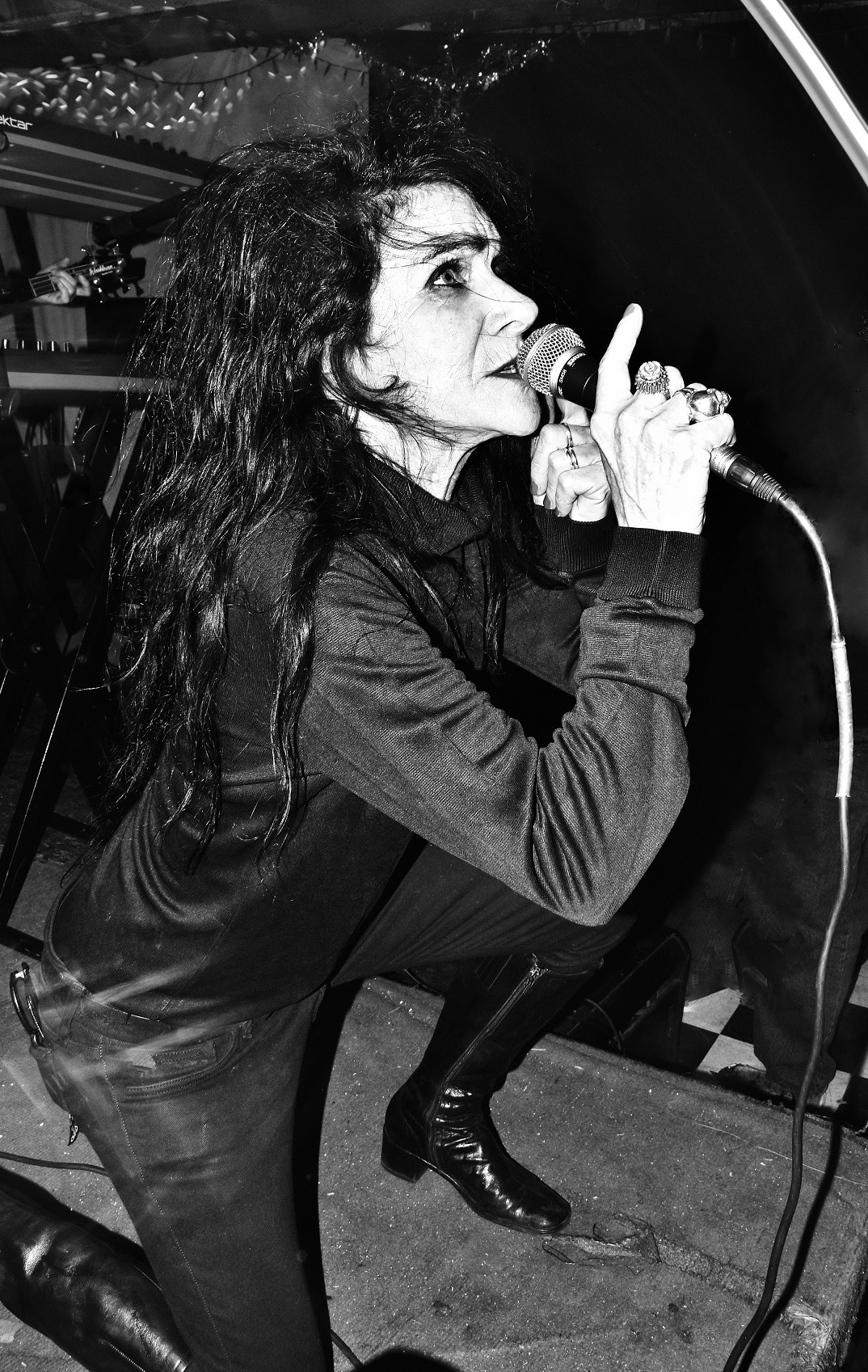
THE VOICE AND SENSUALITY OF A DARK GYPSY DEMON
An interview with Gitane DeMone
In the first half of the 1980s Gitane DeMone was one of the iconic figures of the dark-rock scene, above all through her time in Christian Death, the Californian band that drew a large following on both sides of the Atlantic. Singer and keyboard player, gifted with a particular personal magnetism and a superb, many-shaded voice, she stood alongside the legendary and much-missed Rozz Williams for several years, including after they had both left the group. Her contribution to records widely admired well beyond the gothic circuit – “Catastrophe Ballet”, “Ashes” – ran far deeper than the sleeve notes ever let on. From the 1990s onwards her career has moved between solo work and a wide range of collaborations, holding on to an independent cast of mind and an appetite for experiment that never settles for the easy compromise. Inevitably, it has spilled over into the visual arts, video and literature too. Today she lives in California again, and it is above all with the Gitane DeMone Quartet that her creative adventure continues. Bound by mutual artistic respect, we had a long conversation across more than 9,000 kilometres, touching on many aspects and moments of a rich career and life.
Deca — Gitane… in the first half of the ’80s you were an official member of Christian Death, one of the most iconic and influential bands in international dark-rock. A band born in the United States, in California. Founded by American musicians tied to the West Coast punk and post-punk scene, like Rikk Agnew (Adolescents, D.I.). And yet Christian Death were huge in Europe too. Your sound carried all sorts of cultural influences and your style – especially on albums like Catastrophe Ballet and Ashes – was genuinely eclectic. Plenty of people back then were convinced you were a European band.
Gitane — All of that is true. After the band’s earliest work, aimed at what people call death-rock and at gothic, macabre atmospheres, Rozz wanted to indulge in surrealist culture – what I’d call a romantic surrealism. He told me the title of Catastrophe Ballet and the title of every song on the album took its inspiration from a surrealist painting. And of course Ashes is a great, tragic surrealist love story. In 1984 we toured right before Catastrophe Ballet, playing songs from Only Theatre Of Pain alongside songs just written in Los Angeles for the Catastrophe Ballet sessions. Maybe the European spirit was in the surreal mix of the new Christian Death sound – new lyrics, a new look, French and German turning up on both records.
Christian Death and the Death-Rock Years
Deca — In Christian Death you played piano and keyboards and, above all, you were the female lead vocalist. Step by step, year by year, your voice took on more weight. On records like Atrocities and The Scriptures the highest, most affecting moments are the songs you sing: Tales Of Innocence, say, or that marvellous Hendrix cover, 1983… A Merman I Should Turn To Be. I remember your fans going wild for them. Could that upward curve be exactly what ended your time with Christian Death and pushed you towards new horizons? Was the band becoming too tight a space for where you were going as an artist? I’m thinking of the newsletter you sent us fans in 1989 announcing your resignation, where you wrote “…and yes: there is life after death!”
Gitane — I was principally a singer before I joined Christian Death – that was my first great passion, at least. With the band I could also write music on the keyboards, and Rozz was very open to having a keyboard player who sang backing vocals in the new line-up. I was more than happy to be Rozz Williams’ backing singer. And I felt very lucky to have sung Lament on Ashes as lead vocal. After Rozz left the group I was asked whether I wanted to take Tales Of Innocence as a solo vocal; I in turn suggested we include a version of Gloomy Sunday, because it was a song from the Second World War and a famous song about suicide. Atrocities, after all, is a record about the atrocities of war. For The Scriptures I suggested Jimi Hendrix’s 1983 (A Merman I Should Turn To Be), though I can’t think of much relevance to the album’s subject, the Holy Scriptures, beyond its vision of an apocalyptic Earth. It’s true that at a certain point I became disillusioned with the musical direction the band was taking, but there were also interpersonal dynamics that turned into a deceptive downward spiral. So I left, and I carried on following the music wherever the Muse took me. My choice was a combination of difficulty and the need to move forward as a singer.
Deca — Speaking of keyboards… You know I’m a pianist and a keyboard player, so I’m curious about the organs and synthesizers you were using in those years. Nobody ever asks about this! The keyboards were a big part of the Christian Death sound.
Gitane — The analogue Roland Juno 6 for live shows was my absolute favourite. In the studio I used a Hammond organ with a Leslie cabinet, in a room built specially just for the Leslie. That’s the sound that defines Catastrophe Ballet. I loved it!
Deca — Which singers gave you the strongest push to become one yourself?
Gitane — The great jazz singers – Billie Holiday, Sarah Vaughan, Nina Simone. Unreachable, at that level. I can’t claim to be a jazz singer. There’s so much emotion and substance in those voices. I love Maria Callas’ voice too. And I love the work of Nico, Nina Hagen, Lene Lovich, Lisa Gerrard, Siouxsie. But I never wanted – or was able – to sing in somebody else’s style; I’ve looked for my own mark. Right now, for instance, I’m very interested in learning the Arabic scales properly. I keep studying and experimenting. Singing is simply wonderful and there’s no end to my passion for the voice.
A Solo Career on Her Own Terms
Deca — Your solo career has been varied and fiercely independent. You never chased a trend to shift more records. I know how hard it is to be a genuinely independent musician. The music business has changed enormously over the last twenty years. Are your current projects still exactly as you want them? Have you managed to build a hard core of new fans?
Gitane — Late this year or early next, a collaboration with one of Germany’s most prolific ambient/drone artists, “N”, will come out: in Europe on the British label Denovali Records, in the US on Sacred Hands. It’s an experimental work, complete with a booklet. Four years of work went into it. Also due next year is an orchestral project with the well-known producer and musician Paul Roessler, currently a member of the Gitane DeMone Quartet. It will be called Killing The Chief and it’s my personal tribute to the life of my dear friend Rozz Williams. The Gitane DeMone Quartet is my band and the thing closest to my heart. We were forced to pause through the Covid period, but we’re starting to think about a new album for 2022. Releasing this work with “N”, with Paul Roessler and with my quartet will be a great satisfaction. As for the audience, I can’t say I have many new fans: what I do isn’t necessarily appealing to everyone with a gothic or dark orientation. My audience is small and select. I wander in the dark universe of sound, and I think I always will.
Rozz Williams, Rikk Agnew and Italy
Deca — Your collaboration with Rozz Williams – an undisputed legend in the history of Christian Death and in dark culture generally – came in two phases: up to 1985 in the band, then in the mid-’90s on his solo projects. I imagine your working relationship was different in those two moments. How had Rozz changed during and after Christian Death?
Gitane — Rozz and I were very close friends. We had the same things in common and we always remained two individual personalities. We shared ideas. Nothing ever changed between us, except that he was furious when I decided to stay in Christian Death; but he also understood that I had children with Valor and that I was trying to keep the relationship together for the kids. When I did leave the group he wrote to me immediately and wanted us to work together. He stayed creatively prolific with all his projects. He was a true artist. I admired him enormously then, and I will love him forever.
Deca — You’re now married to Rikk Agnew, the very first Christian Death guitarist, who played on Only Theatre Of Pain. There’s something of a romantic film about that! The two of you never played in the band together, but you were both members. What’s it like comparing notes on those old days?
Gitane — Rikk was in Christian Death for about a year, at the very beginning. Our experiences were completely different. I love his stories, especially the ones about recording Only Theatre Of Pain. My own experience wasn’t remotely normal. When I joined the band I was pregnant with my son Sevan, I set off on the first Christian Death European tour and then came the recording of Catastrophe Ballet at the start of 1984. I gave birth in London in March and we had to postpone the show at Specimen’s Batcave, because I’d gone into labour! My time in Christian Death was largely the experience of being a young mother.
Deca — You have Italian roots, if I remember rightly. What’s your feeling for Italy? Christian Death made the famous EP The Wind Kissed Picture in 1985 at Regson studios in Milan. The vinyl for my own first album was cut in those same studios the following year – that’s when I met your sound engineer, Kevin. Anything you’d like to say to your Italian fans?
Gitane — I adored that studio, and the friends we made in Milan, in the rest of Italy and above all in Sicily. I was so happy in those days. I love Italy and I have to keep faith that I’ll be able to come back and play there and experience the beauty of the people and the country again.
Deca — One last thing: why Gitane, and why DeMone? I’ve never found any specific information or anecdote about your stage name.
Gitane — Maybe because I was possessed by a gypsy demon?… That’s what I was told once.