
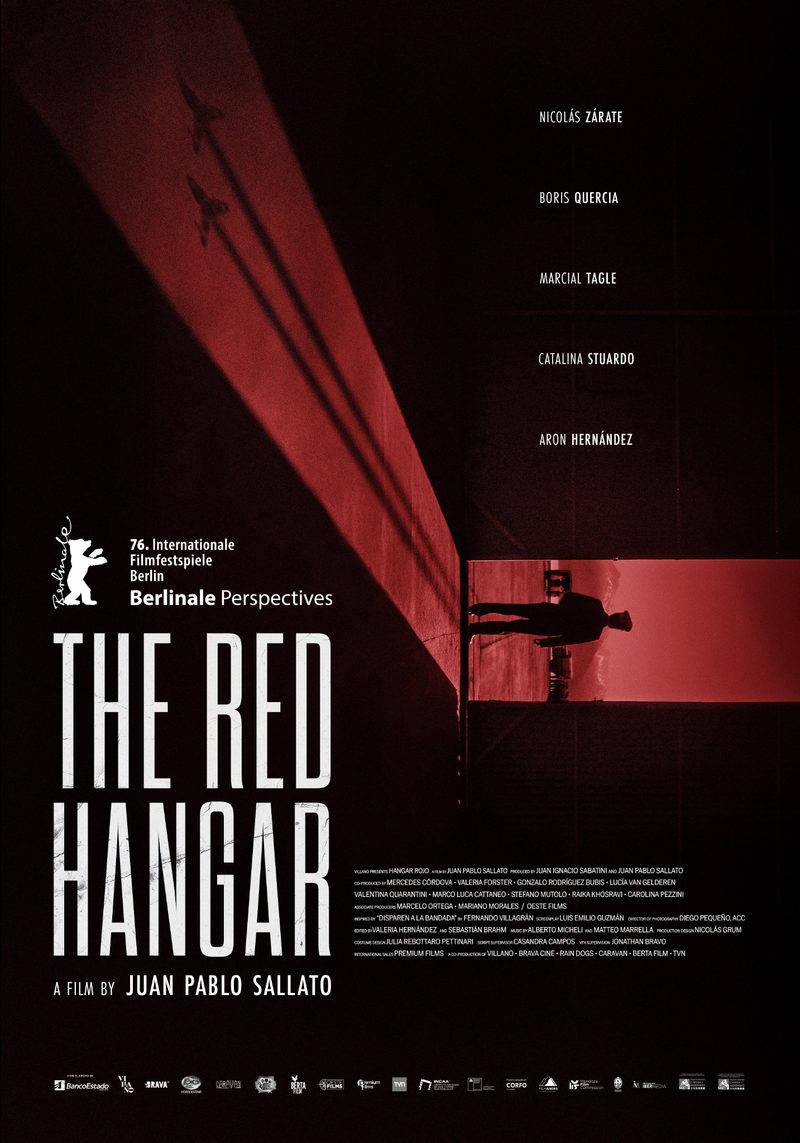
We know what happened in Chile on September 11, 1973. We know what the military coup meant for the country and what followed. Still, I wasn’t prepared for how tense Juan Pablo Sallato’s Hangar Rojo would make me feel. From the opening minutes, there is a sense that something terrible is about to happen. That feeling never really goes away.
The story follows Captain Jorge Silva (Nicolás Zárate), an officer at the Chilean Air Force Academy who previously helped prevent an attempt on Salvador Allende’s life. Now, with the coup underway, he finds himself inside an institution preparing to participate in the repression. His military training demands obedience, but his convictions are pulling him in another direction.
What makes the film exceptional is how little violence Sallato needs to show. There are no endless scenes of torture or bloodshed. Instead, violence is everywhere without necessarily being visible. Behind doors, in the sounds coming from other rooms, in conversations where nobody needs to explain what might happen next. You spend much of the film expecting the worst.
The black-and-white cinematography adds another layer to this atmosphere. It gives the film a darkness that feels almost physical. There is something deeply uncomfortable about those corridors, offices and military spaces. Even when nothing particularly threatening is happening on screen, you never feel safe.
The performances are extraordinary.
Nicolás Zárate is excellent as Silva. His character is a military man, trained to control his emotions, and Zárate never forgets that. Somehow, he manages to communicate everything happening inside Silva without needing to make those emotions obvious. The conflict is there, even when his expression barely changes.
But Marcial Tagle, playing Colonel Mario Jahn, is genuinely terrifying. What impressed me most is how rarely he raises his voice. He doesn’t need to shout, lose control or act violently to make his presence disturbing. His manner, his expressions and the way he speaks are enough. Every time he appears, you wonder what he might do next. He knows the power he has, and that makes him even more frightening.
There is also something particularly interesting about watching these events from inside the military itself. Silva belongs to the institution responsible for the repression, but he is forced to confront what obedience actually means. His personal conflict cannot erase the responsibility of the institution he serves.
Watching this from Argentina, it is impossible not to think about our own dictatorship and the consequences of following orders without questioning them.
Hangar Rojo is an exceptional film. It maintains an extraordinary level of tension without relying on graphic violence, supported by two remarkable performances and a visual atmosphere that stays with you long after it ends.
Sometimes the most frightening violence is the violence you know is there, even when the camera refuses to show it.
Film details
Directed by Juan Pablo Sallato
Starring Nicolás Zárate and Marcial Tagle
Berlinale Perspectives, 2026