
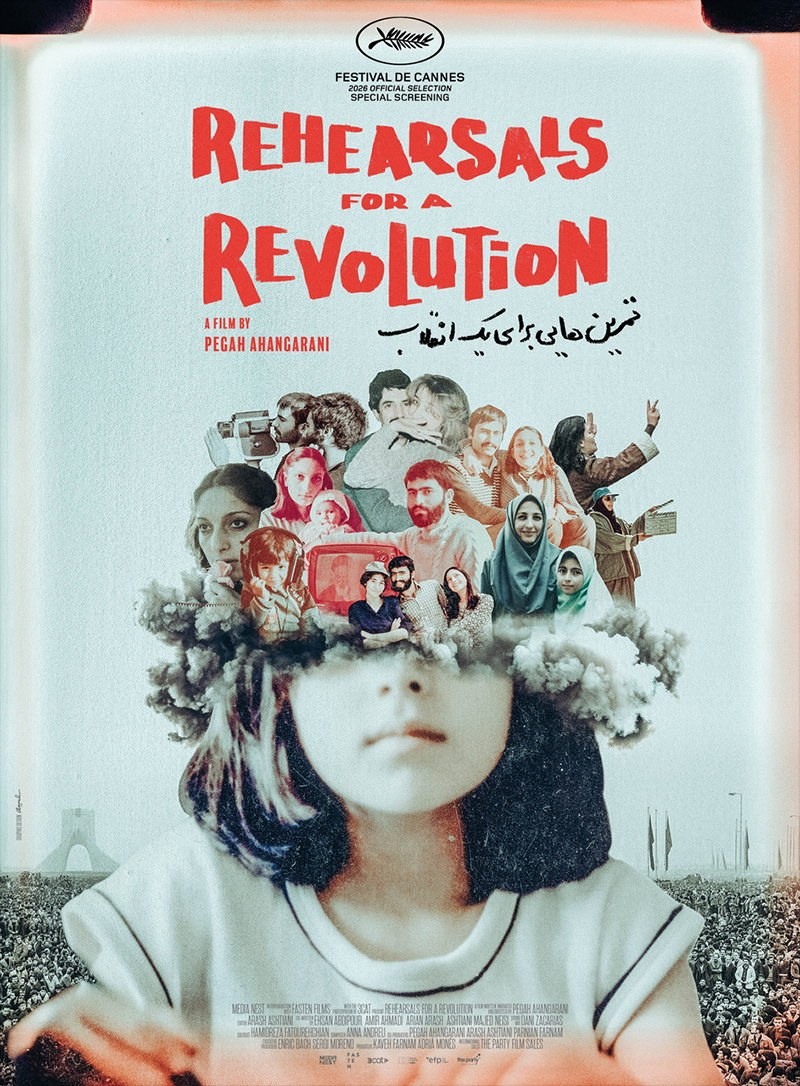
Pegah Ahangarani tells Iran’s recent history through people she has loved, admired and tried to understand. That choice gives Rehearsals for a Revolution much of its force. A political decision can change what happens inside a family for decades. Here, those consequences have faces, voices and a place in someone’s memory.
Across five chapters, the filmmaker brings together personal archives, home movies and footage of public unrest, following more than forty years of Iranian life. Her own story develops through those of relatives and people who helped shape her. The movement between private experience and national history is remarkably clear. You can follow the larger events while understanding why a particular person matters to the woman telling the story.
The narration is exceptional. Ahangarani knows how to give information emotional weight without losing the thread. Her father’s early revolutionary commitment and subsequent disillusionment, the influence of a schoolteacher, and her own experience of the 2009 Green Movement bring different expectations of change into the story. Even when the history becomes complicated, the storytelling holds. The people remain distinct, and so do the hopes they invested in it.
That is especially important in a film concerned with successive generations of political belief and disappointment. It takes people seriously enough to consider what they thought was possible when they acted. Looking back, we can see consequences they could not have known. The distance between those two positions gives the documentary much of its sadness.
It also makes the work with archival material particularly compelling. Family images carry the knowledge of what came afterwards. Public footage becomes more immediate once it is connected to someone whose life we have begun to follow. Ahangarani builds those relationships patiently, giving the material a purpose beyond establishing that an event occurred.
What stayed with me was the persistence of the desire for a different life. Repression reaches into friendships, families and the way people remember one another. Yet the possibility of change keeps returning. The film gives a sense of how much that persistence asks of people, including those who have already watched earlier hopes collapse.
The ending is the one place where I felt the film lose some of its force. After so much precise, personal storytelling, it lands somewhere more familiar than I had hoped. For me, that takes a little weight away from what came before. The documentary has already earned its emotional response through the specificity of these lives; its conclusion feels less distinctive than the work that leads to it.
That reservation belongs in an otherwise very strong recommendation. Rehearsals for a Revolution is an impressive piece of documentary storytelling, and an especially valuable film for anyone with only a partial understanding of Iran’s recent history. Ahangarani gives that history a human continuity. By the end, the distance between events you may have read about and lives you have spent time with has become considerably smaller.