
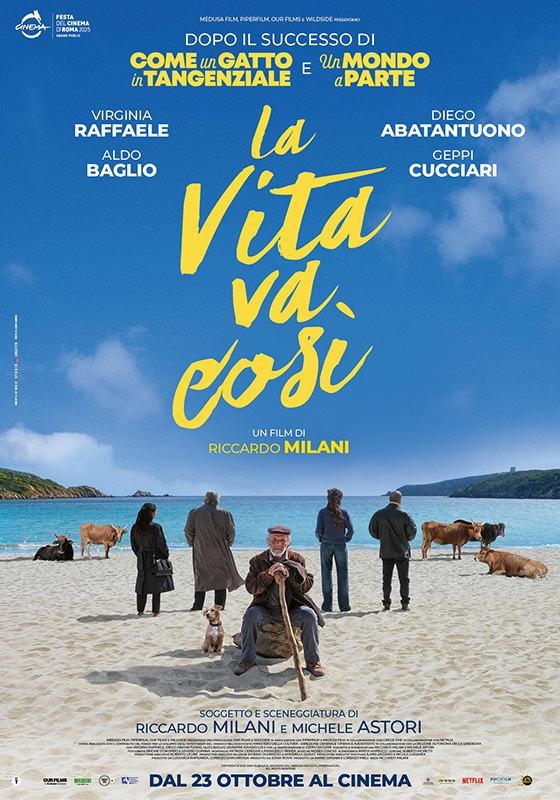
On New Year’s Eve in 2000, two very different worlds are celebrating. Giacomo, a millionaire property developer, is throwing an extravagant party. Meanwhile, on the coast of Sardinia, an elderly shepherd named Efisio is having dinner with his family. They don’t know each other yet, but Giacomo has plans for the land where Efisio lives.
The plan sounds familiar: an “eco-sustainable” tourist resort, thousands of jobs and a wonderful future for the local economy. There’s just one problem. Efisio doesn’t want to sell his land, no matter how much money they offer him.
And suddenly, he’s the problem.
What I found particularly interesting is how quickly the rest of the town turns against him. The company promises around 2,500 jobs, something difficult to ignore in a place where younger generations often have to leave to find work. I can understand why people would be tempted. But watching an entire community pressure one of its own members to surrender his home to a millionaire developer is something else.
Especially when the company is already destroying native vegetation to build its supposedly sustainable paradise.
Riccardo Milani tells this story through a very recognizable kind of Italian comedy. There are physical jokes, plenty of vaffanculo, ridiculous situations and even the obligatory comic priests. The landscapes are beautiful, the cast is excellent, and the whole thing has that polished, almost streaming-platform look that sometimes makes films feel a little too clean.
I don’t love everything about that approach. Some of the humor feels predictable, and the film occasionally resembles the kind of Italian commercial comedy we’ve seen many times before. But underneath all that, there’s a story worth telling.
And much of that comes from Giuseppe Ignazio Loi, the 84-year-old shepherd playing Efisio, despite having no previous professional acting experience. He can be incredibly stubborn, sometimes even irritating. But little by little, you begin to understand him. He’s not trying to change anyone else’s life. He simply wants to keep living his own.
The film is inspired by the real story of Ovidio Marras, who spent years resisting a tourist development project in Sardinia. Knowing that makes everything even more interesting.
Because this is not particularly an Italian problem.
We live in a world where almost everything has a price. Land, beaches, housing, natural resources, public spaces. Even the places where generations of families have lived are constantly being evaluated according to how much money someone could make from them.
And somehow, we’ve accepted the idea that this is progress.
I find it extraordinary how current the subject feels. A company arrives promising jobs and prosperity, calls its project sustainable, and suddenly anyone who questions it becomes an obstacle to the future. We see versions of this happening everywhere.
La vita va così is funny, entertaining and sometimes a little too conventional. But it also leaves you thinking about what we’re willing to sacrifice in the name of development, and who actually benefits from those sacrifices.
Maybe the most uncomfortable thing about Efisio isn’t his refusal to sell. It’s that, in a world where everything supposedly has a price, he reminds us that some things shouldn’t.
Film details
Italy | 2025 | 118 minutes
Directed by Riccardo Milani
Written by Michele Astori and Riccardo Milani
Cast: Diego Abatantuono, Pietro Ragusa, Aldo Baglio, Geppi Cucciari, Virginia Raffaele and Giuseppe Ignazio Loi